Introduction
I was watching a Cleveland State basketball game with Bob Costas commentary when my three-year-old niece began sweeping the floor with her tiny wooden broom. The contrast between the professional athleticism on screen and her earnest domestic efforts struck me as profoundly connected. Both represented forms of mastery—one highly visible and celebrated, the other quietly developmental. This Melissa & Doug cleaning set became my window into understanding how children process the adult world through imitation, and how something as simple as a child-sized broom can reveal complex developmental patterns.
Real-life Context
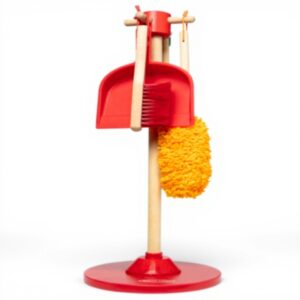
The cleaning set arrived on a Tuesday afternoon, the cardboard box slightly damp from spring rain. My niece’s immediate reaction wasn’t excitement about a new toy but recognition of familiar objects. She pointed at the broom and said “Mama’s,” though her mother’s actual broom stood twice her height in the kitchen corner. What fascinated me was how she didn’t see these as toys but as tools—proper tools that happened to fit her hands. The wooden stand became her organizational center, though she initially struggled to hang the pieces properly, often leaving the dustpan leaning against furniture legs. The sound of the wooden broom bristles scraping across hardwood had a different texture than the swish of adult cleaning tools—softer, more tentative, like someone learning a language through careful repetition rather than fluency.
Over several weeks, I noticed her developing rituals. After breakfast, she’d retrieve the broom to sweep imaginary crumbs, her movements mirroring what she’d observed during actual cleanups. The play kitchen became her domain, where she’d meticulously arrange the six pieces before “cleaning” plastic food containers. What surprised me was the seriousness she brought to these activities—no giggling or exaggerated play-acting, but focused concentration as if she were practicing essential life skills. The colored accents on the natural wood seemed to help her distinguish functions, the red-handled dustpan always paired with the yellow-handled brush in her system.
Detailed Observation
The physical interaction between child and object revealed more than any product description could capture. Her small hands wrapped around the broom handle with both palms facing forward, a grip she’d likely observed but couldn’t yet replicate with adult-sized tools. I watched her navigate the learning curve of coordinating brush and dustpan—initially sweeping debris toward the pan only to watch it scatter when she lifted too quickly. After three days of practice, she developed a technique of holding the dustpan with one foot while sweeping with careful, controlled strokes.
- The broom measures 28.5 cm wide, perfectly spanning a child’s arm reach
- Natural wood construction provides just enough weight for sensor feedback without strain
- Six pieces create a complete cleaning ecosystem that mirrors adult tools
- The storage stand requires spatial understanding to organize properly
- Color coding helps children associate tools with specific functions
The mop presented the biggest challenge—its longer handle required different body mechanics than the shorter tools. She’d often tilt it too far forward, losing control of the head. What caught me off guard was how she adapted, eventually developing a two-handed technique that allowed better leverage. The dusting wand became her favorite for high surfaces, though she couldn’t reach most of them. Instead, she’d stand on tiptoe to dust chair legs and table edges, her face serious with concentration. The absence of batteries or electronic components meant every action required physical engagement—no shortcuts, just the direct relationship between movement and result.
I didn’t realize at the time how much the storage system would matter. The wooden stand seemed like an organizational convenience initially, but watching her struggle to hang each piece properly revealed its developmental value. She had to align the hook slots just right, applying enough pressure to secure them without knocking other tools off. The first week, she’d often abandon the effort, leaving pieces scattered. By the third week, she’d developed a specific order for hanging—broom first, then mop, then the smaller tools—and could complete the task with focused determination.
Reflection
Watching Cleveland State basketball players execute complex plays while my niece mastered basic cleaning motions created an unexpected parallel in my mind. Both represented forms of practice leading toward competence, though at vastly different scales. The players’ hours of drills mirrored her repetitive sweeping motions—both building muscle memory for future application. Bob Costas’ commentary about player development echoed in my thoughts as I observed how children develop domestic competencies through imitation.
The texture of the wooden handles became familiar through observation—smooth but not slippery, with just enough grain to provide grip. After several weeks, I noticed subtle wear patterns where her small fingers consistently gripped the broom handle, a physical record of her practice. The sound of the wooden pieces clicking together when she carried the entire set had a specific cadence—softer than plastic, more substantial. These sensory details anchored the experience in reality, far removed from marketing claims about educational value.
What became clear was that the value wasn’t in the objects themselves but in what they enabled—the translation of observed adult behavior into achievable child-sized actions. The set’s limitation of being purely manual became its strength, requiring full physical engagement rather than passive entertainment. The trade-off emerged in the coordination required—younger children needed adult guidance initially to understand how the pieces worked together, particularly the dustpan and brush combination that required bilateral coordination she was still developing.
Moving past the surface, I began noticing how her play cleaning evolved into genuine help. She’d actually sweep up small messes, her movements becoming more efficient through practice. The line between play and participation blurred until she was genuinely contributing to household tasks, not just mimicking them. This transition happened gradually, almost imperceptibly, until one day I realized she was systematically cleaning her play area without prompting, the tools having become extensions of her capability rather than novelties.
Conclusion
The cleaning set eventually found its permanent place in the kitchen corner, no longer segregated as a toy but integrated into household tools. My niece’s competency grew with repetition, her movements becoming more fluid and purposeful. The initial challenges—the coordination required between brush and dustpan, the proper storage on the wooden stand—became automated through practice, much like athletic skills develop through consistent training.
The parallel between elite basketball and childhood development seems less strange to me now. Both involve observation, imitation, practice, and eventual mastery, though the arenas differ dramatically. The wooden cleaning tools served as bridges between the adult world children observe and the skills they can actually perform, their scaled-down proportions making competence achievable. The quiet satisfaction on my niece’s face when she successfully cleaned her area mirrored the pride of an athlete executing a well-practiced play—different contexts, similar human experiences of developing capability through dedicated practice.